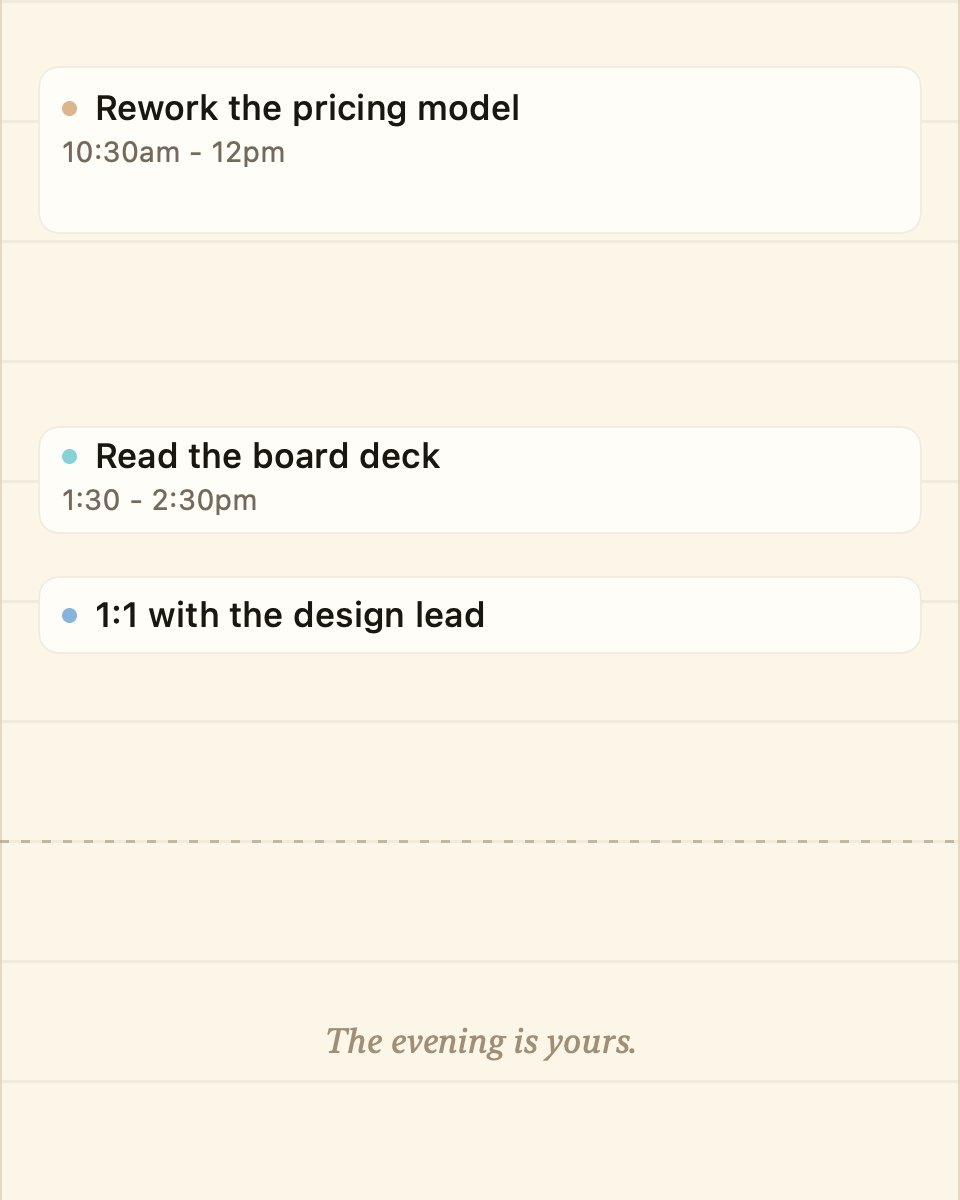
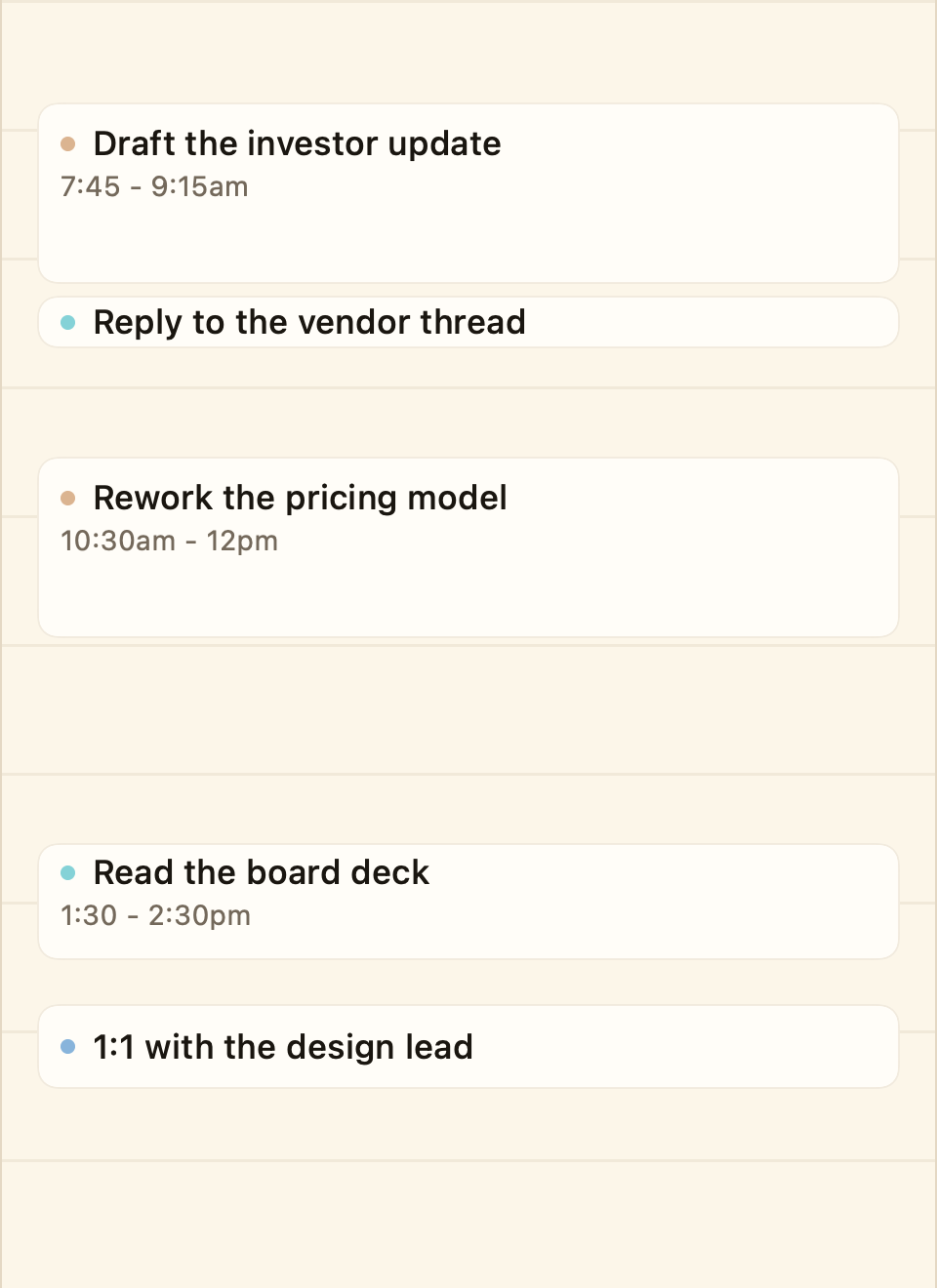
Every other productivity app hands you an endless list and calls that
freedom. Vene reads how much each task actually asks of your head and
fits a day you can really finish. Then it draws a line at the end and
keeps your evening safe on the far side, because that evening is the
part of the day worth protecting.
There is the streak that breaks the first day you are tired, the
badge that quietly goes grey, and the red number that follows you all
the way to dinner. The list never ends, so you are never done, and a
tool that never lets you be done has quietly decided how you are
allowed to feel.
They count the evenings you stepped away as failures and call that
motivation. We think that is a design flaw, and the flaw is in the
tools. It was never in you.
folio iii · the reframe
Vene has one real job.
It is your guilt‑eliminator.
The anti-guilt law
“Vene only ever reacts to what you did,
never to what you didn’t.”
It warms to what you do and stays quiet about what
you skip. Vene refuses to register your absence at all, so there is
nothing inside it that can break, lapse, go grey, or turn red while you
are out living your life.
A finish you walk toward
Vene tells you “you’ll be done around four” instead
of “5h 12m of freedom left.” It is the same information
either way, but the first one feels like walking toward a place you can
see, while the second feels like watching a tank drain. We chose the
version that lets you breathe.
Edges make time precious
An open-ended day keeps promising there is always more time later, so
no single hour feels worth protecting and the whole day slips by
half‑used. Give the day a clear end and the hours before it become
the only ones you have, which is exactly when you start to spend them with
care. Vene draws that end, so the time inside it begins to count.
It trusts your record
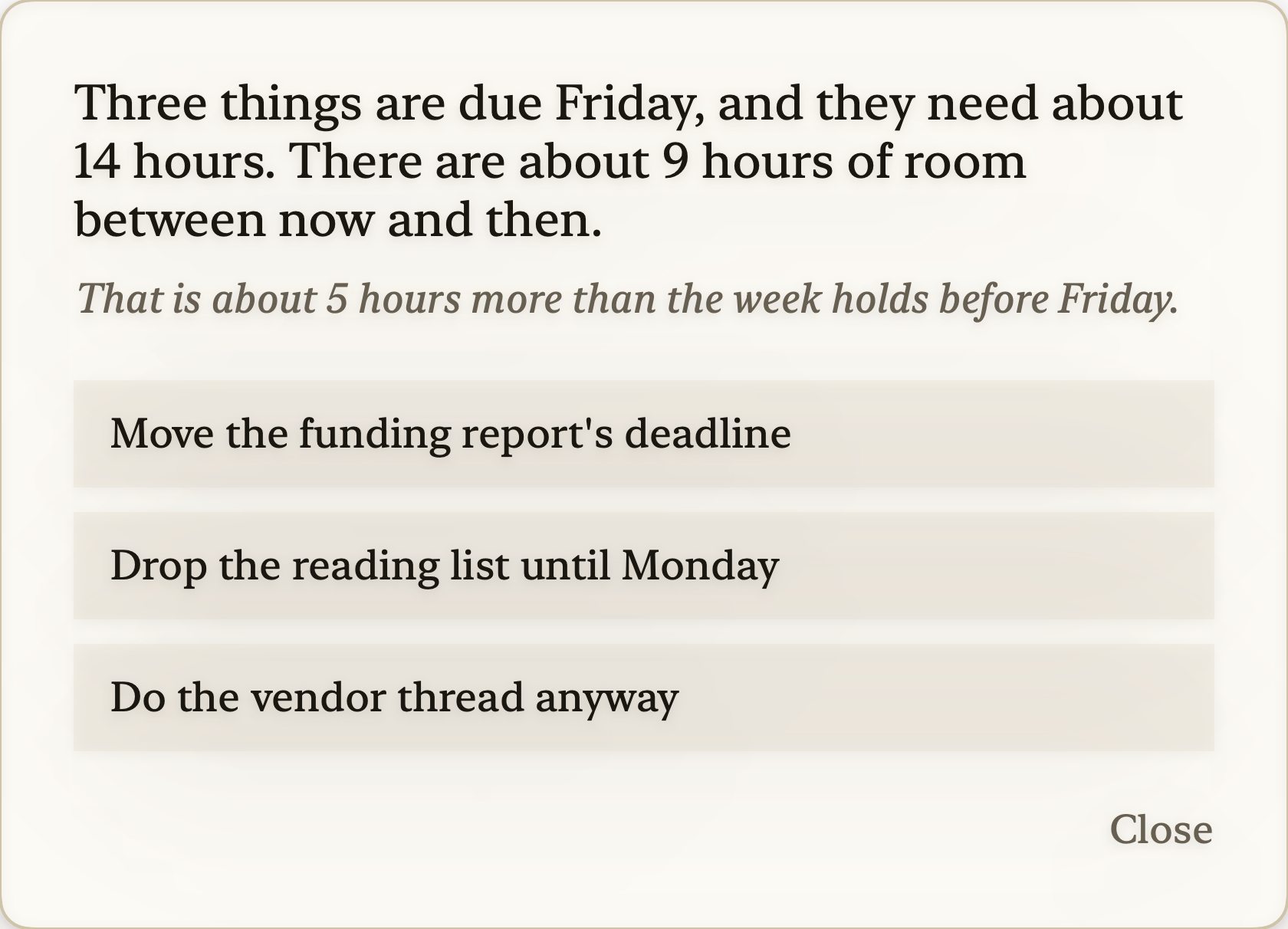
When the day has to flex, Vene sets the cap from what you have
actually finished before, rather than from how heroic you felt while
planning it. Planning-you is an optimist, so someone has to keep the
books honest, and Vene would rather trust your history than your mood.
folio iv · the mechanics
How a finishable day is built
You do not need more
willpower. The restraint is built into the engine, so you never have to
supply it yourself.
i
Cognitive load over clock time
Three hours of deep work will cost you far more than three hours of
email, and your brain knows the difference even when your calendar
pretends otherwise. Vene reads each task, scores how much of your mind
it will take on a scale of 0 to 1, then puts the heavy thinking inside
your peak hours and leaves the shallow work for the edges of the
day.
ii
The bounded day
Six cognitive units a day is a real ceiling, set from the research
on how long a person can sustain genuinely demanding work. It comes to
about three or four hours of maximum-load thinking, which is less than
any of us would like, and Vene would rather tell you the truth than
flatter you.
iii
The evening ritual
Plan tomorrow while it is still tonight, because tonight-you still
has judgment and morning-you should not have to negotiate with a blank
day. You pick the few things that have earned a place, you see what
they will honestly cost, and you seal it, so you wake up to a day that
is already decided.
iv
The edge of your day, drawn at dusk and defended all evening.
The edge
Vene draws a finish line ahead of time, from your chronotype and
the daylight you actually get that day. Work has to fit before that
line. Past it, the evening holds whether or not you finished
everything you meant to, because rest here is something you are
promised rather than something you have to earn.
Also in the engine · schedules around your chronotype
· batches similar work into flow · inserts real breaks,
scaled to the work · learns your honest pace per load, then
believes it · reschedules quietly when the day moves
· and when the day moves ·
9 amnoon3 pmdusk
Deep workheavy
Reviewmedium
Emaillight
Deadline2 pm
your evening
A deadline landed at two o’clock. The day rebuilt itself around it and
still finished before your edge, without once asking you to move a block.
A small schedule of the day. At first the deep work sits in the
morning, with email and a review in the afternoon, all of it finishing before the evening
edge. A two o’clock deadline then arrives, and the blocks rearrange on their own:
the deep work stays in the morning peak, the deadline takes the early afternoon, and the
light email slides to the end of the day, still inside the edge.
folio v · the evening
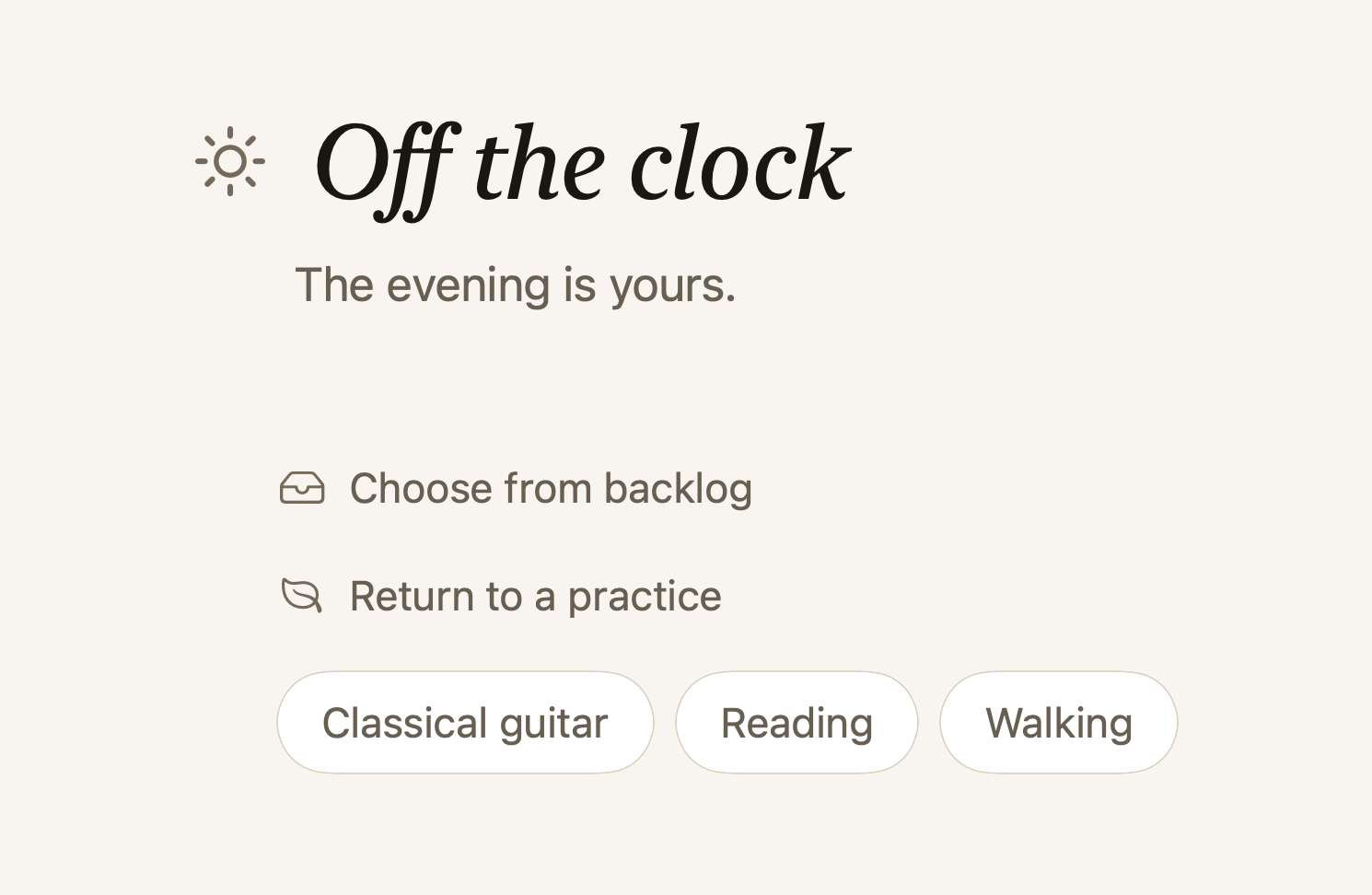
And the evening is yours.
When the work is done and nothing is still tugging at you, the evening
finally turns into something you can use. The guitar you keep meaning to
pick up, played at nine because nothing is waiting on you. The book that
has sat by your bed for a month, read for an hour with no reason to stop.
A walk with no particular destination, just to see where the light goes.
None of it earns a badge or moves a number, and that is the whole reason
it is worth protecting.
The Greeks had a name for
an evening like that. σχολή.
A few thousand evenings like that, spent on the things you keep
choosing for yourself, are what slowly turn you into someone.
Which raises the question of who.
folio vi · the portrait hall
The ones who knew
Long before anyone said
“productivity,” there was the uomo universale, the
kind of person who treated their own range as a life’s work. None
of them had a system or an app. What they had was a bounded day, and
the freedom that the edges of it bought them.
keep scrolling to walk the hall
Leonardo da Vinci1452–1519Painter, engineer, anatomist, lutenist
Seven thousand pages of his notebooks survive, filled with
mirror-script marginalia on water, on flight, on grocery lists, on
the moon. The evenings did that work. The commissions only paid for
it.
He gave the world the Sistine ceiling and the David, and he also
left three hundred poems that nobody commissioned. Ancora
imparo, he is said to have written at eighty-seven, which means
“I am still learning.”
He ground a Dutch spyglass into a telescope, turned it on the night
sky, and came back with mountains on the moon and four small moons
circling Jupiter. Between the heresies he timed a swinging lamp into
the law of the pendulum and played the lute his father wrote the
theory for.
Isaac Newton1643–1727Physicist, mathematician, astronomer, alchemist
Sent home from Cambridge by the plague, he spent two quiet years
inventing the calculus, splitting white light into its colours, and
working out why the moon does not fall. He later called those
shut‑in years the prime of his age for invention, and most of it
happened in his mother’s garden.
Benjamin Franklin1706–1790Printer, scientist, statesman, inventor
He sold off his printing house at forty‑two so he would
finally have time to think, then spent the rest of his life flying
kites into storms, drawing the lightning rod and bifocals out of
them, and charting the Gulf Stream from the deck of a ship. He treated
the back half of his life as the part he had been working toward.
Reserved.
Youin some yearsPolymath of whatever you keep choosing
This one gets built out of ordinary evenings, one evening at a
time, and never out of streaks. It is the only portrait Vene is
actually trying to help you make.
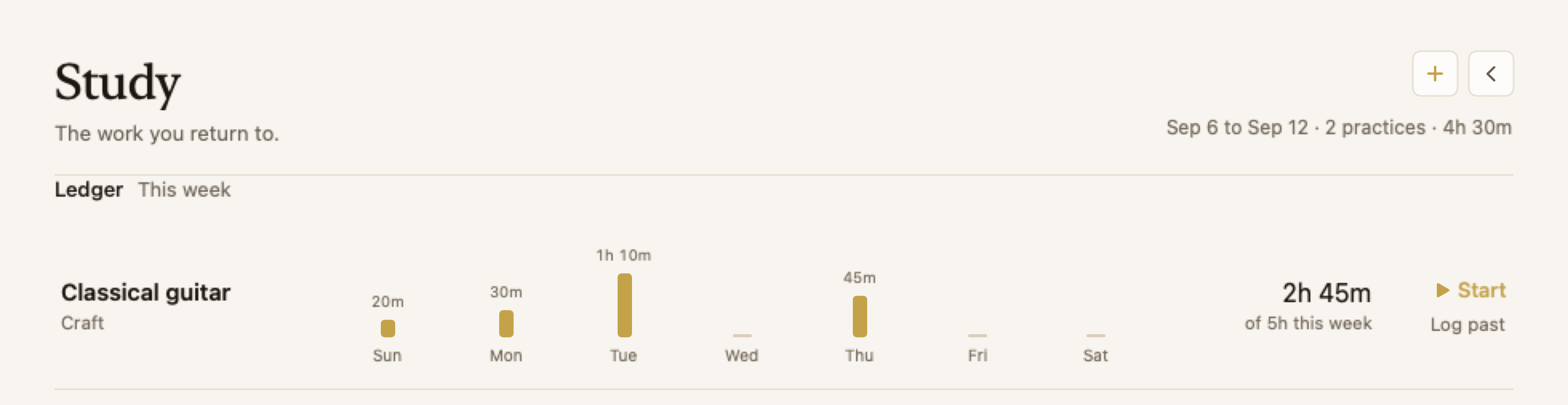
A streak is a number that is designed to die, because the whole
point of it is to punish the first day you miss. Vene keeps a different
kind of number, which is simply everything you have ever put into a
practice, and it only ever grows. It does not break, it does not reset,
and it never once notices a day you missed.
The polymath is built out of the evenings you do reach for
the guitar. That only keeps happening if the evenings you don’t
reach for it are allowed to cost you nothing.